ADVERTISEMENT
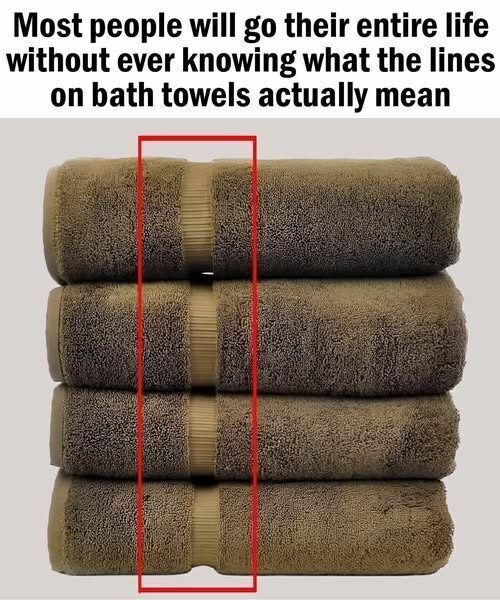
The mundane objects of our daily lives are often the ones we scrutinize the least. We wrap ourselves in bath towels every morning, yet few of us stop to consider the engineering behind the fabric. However, a seemingly trivial question recently ignited a firestorm of digital discourse: what, exactly, is the purpose of that mysterious, raised line or decorative strip found near the edges of almost every bath towel? What began as a casual query on social media quickly evolved into a viral sensation, proving that the internet has an insatiable appetite for solving the “micro-mysteries” of the domestic world.
Much like the legendary debates over the color of a certain dress or the proper orientation of a toilet paper roll, the “towel line” mystery captivated thousands. On platforms like X (formerly Twitter), the conversation was a colorful mix of comedy and genuine bewilderment. Users offered a variety of creative, albeit incorrect, theories. Some joked that the line served as a “demilitarized zone” to separate the part of the towel used for the face from the part used for the rest of the body. Others suggested the lines were “racing stripes” designed to help the towel dry at aerodynamic speeds, while some assumed they were merely a lingering tradition from a bygone era of textile manufacturing.
Textile professionals eventually stepped in to provide the definitive answer, introducing the public to a term most had never heard: the dobby border. Far from being a mere decorative flourish or a “butt-to-face” divider, the dobby border is a functional powerhouse. It is a specific weave—distinct from the “terry” loops that make up the rest of the towel—created using a dobby loom. This loom allows for the creation of small, geometric patterns and a tighter, flatter weave than the surrounding pile.
The primary reason for the existence of the dobby border is structural integrity. A towel undergoes an incredible amount of stress during its lifecycle. It is soaked, rubbed against skin, twisted, and subjected to the high-heat, high-friction environment of modern washing machines and dryers. Without reinforcement, the edges of a towel would be prone to “pulling” or “bowing,” where the fabric stretches unevenly and eventually frays. The dobby border acts as a stabilizing anchor. Because the weave in this strip is tighter and more compact than the absorbent loops, it resists stretching and maintains the towel’s rectangular shape through hundreds of laundry cycles.
ADVERTISEMENT
