ADVERTISEMENT
What began as curiosity turned into certainty, and she pivoted toward professional training at the American Academy of Dramatic Arts, graduating in 1925. That classical foundation mattered. She wasn’t raised by sitcom rhythms or Hollywood shortcuts. She came up through rehearsal rooms, through stagecraft, through the kind of work where you earn your space by hitting your marks and telling the truth in a scene, even when you’re terrified. That background followed her into every medium she touched, giving her performances a quiet precision that could read as effortless on screen, but was built from steel underneath.
After the Academy, she joined touring productions and worked the regional circuit, building her career the hard way—one city, one stage, one audience at a time. Broadway credits came, including early work in comedies and more substantial roles that expanded her reputation in theatrical circles. She shared stages with prominent actors and earned a name as someone reliable, sharp, and serious about craft. This wasn’t celebrity. This was a working actor’s life: suitcases, scripts, and constant reinvention.
Her film career arrived in supporting roles rather than star turns. One of her best-known appearances outside Mayberry was in The Day the Earth Stood Still (1951), where she played Mrs. Barley. It was the kind of part that didn’t dominate the screen but left an imprint—an ordinary human presence inside an extraordinary story. That was a pattern with Bavier: she made “ordinary” feel grounded, specific, lived-in.
Television was still evolving in the 1950s, and she stepped into it gradually through anthology series and guest roles, bringing stage discipline to a medium that often moved faster and demanded less rehearsal. She also held a recurring part as Amy Morgan on It’s a Great Life in the mid-1950s, giving her a foothold in a format that would soon become the center of American entertainment.
Then, in 1960, came the role that would cement her forever.
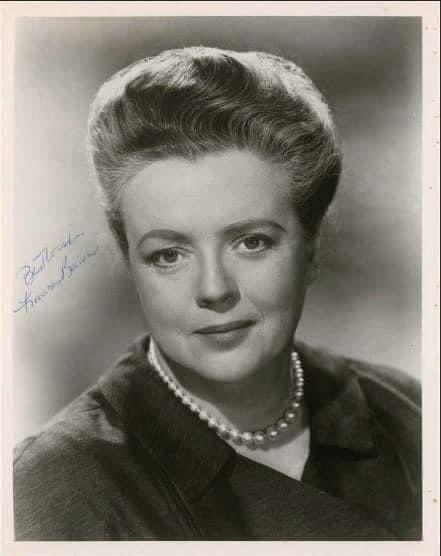
The Andy Griffith Show wasn’t just a sitcom. It was a carefully tuned machine of gentle humor, human decency, and small-town storytelling, and Frances Bavier’s Aunt Bee became the emotional anchor. She arrived in Mayberry as Andy Taylor’s aunt, stepping in to help raise young Opie, and quickly felt like the household’s spine. In a town full of big personalities—Barney Fife’s anxious swagger, Floyd’s gossip, the endless parade of eccentrics—Aunt Bee held the center with calm authority and a soft edge that never tipped into weakness.
Her performance worked because it wasn’t fake warmth. It had texture. Aunt Bee could fuss, scold, worry, and still feel lovable. She could be tender without becoming fragile, firm without becoming cold. Bavier’s timing was sharp, but her greatest tool was restraint. She didn’t push for laughs. She let truth generate the humor. That’s why Aunt Bee still lands decades later: the character isn’t a cartoon. She’s a person.
In 1967, that work earned Bavier a Primetime Emmy for Outstanding Supporting Actress in a Comedy Series. The award wasn’t just recognition of popularity. It was recognition of craft. She had built a character so believable that viewers didn’t think of her as acting. They thought of her as family.
But being beloved on screen didn’t guarantee ease behind it.
ADVERTISEMENT
